Origo
A data platform for governing data platforms.
Harvard University Design Engineering
Master's Thesis
About
Problem Spotting
The Cambridge-Analytica Data scandal broke out April 2018. My Statement of Purpose was written November / December 2017. At the time of writing, I saw theoretical problem of tech ethics as an interesting intellectual exercise.
The theoretical framing was possible due to my undergraduate training in architecture and design at UC Berkeley. The program has a history of interdisciplinary engagement with social justice and wicked problems.
My continued time in practice led me to focusing the thesis on data ethics.
Historical Analysis
Starting at the macro-level, I needed to understand the range of tech's ethical problems from multiple perspectives. I decided to collect case studies from media articles due to their public-facing nature and contribution to mass understanding of the discourse. I then structured the articles to identify the stakeholders that needed to be accounted for in the platform design.
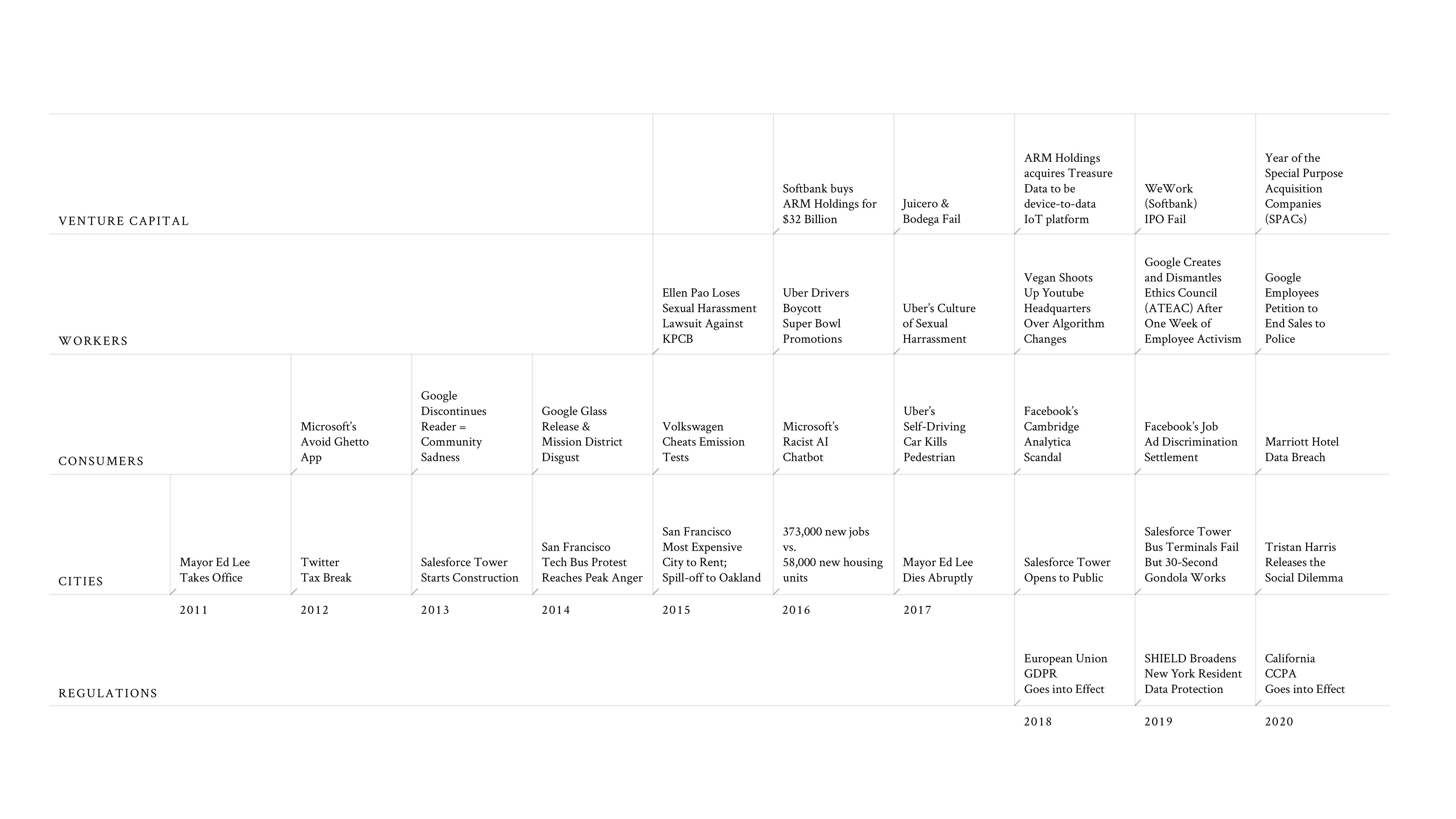
When I left, Silicon Valley politics became inter/national politics.
The timeline shows a sample of major events during this time, including my own company's acquisition by ARM Holding as part of their device-to-data IoT strategy.
"Cities" is not a stakeholder, but technology impacts urban space.
Mainstream Media Landscape
Given the history of yellow journalism, the media is not an impartial reporter. It fails to have the domain knowledge for understanding the root causes of problems and is incentivized to sensationalize. What the public receives from the media are observations of effects of mechanical failures, not the mechanical failures themselves. It is critical to be able to distinguish between the two in order to mitigate internal bias as a designer. Scapegoating is unethical.
At the same time, the media has immense power to create change through influence by creating a shared cultural consciousness. Like how it is important to assess the failures of tech, it is equally important to understand the failures of the changes that have been introduced due to media reporting. A system map synthesized the literature review.

The information reported are usually outcomes and effects, not causes, which means public literacy of technology does not increase. Attitude towards tech also becomes increasingly negative, which creates a potential risk of scapegoating.
As governments respond to problems, the regulations are not designed with technology in mind. A case study is the consent form now on every website which do not benefit the public and are only for companies to protect themselves.
Since there is an obvious problem, people want to step in and help. Others, including academics, want to step in and capitalize on a hot moment (Floridi). This creates an influx of information and can lead to ethics-washing (Floridi). Technologists may be caught in a vicious cycle of scapegoating which is, ironically, unethical.
Misfit regulations can also lead to infrastructural bloat which can impact future use cases, particularly in domains of healthcare and climate change, in unknown ways.
Semi-Structured Interviews
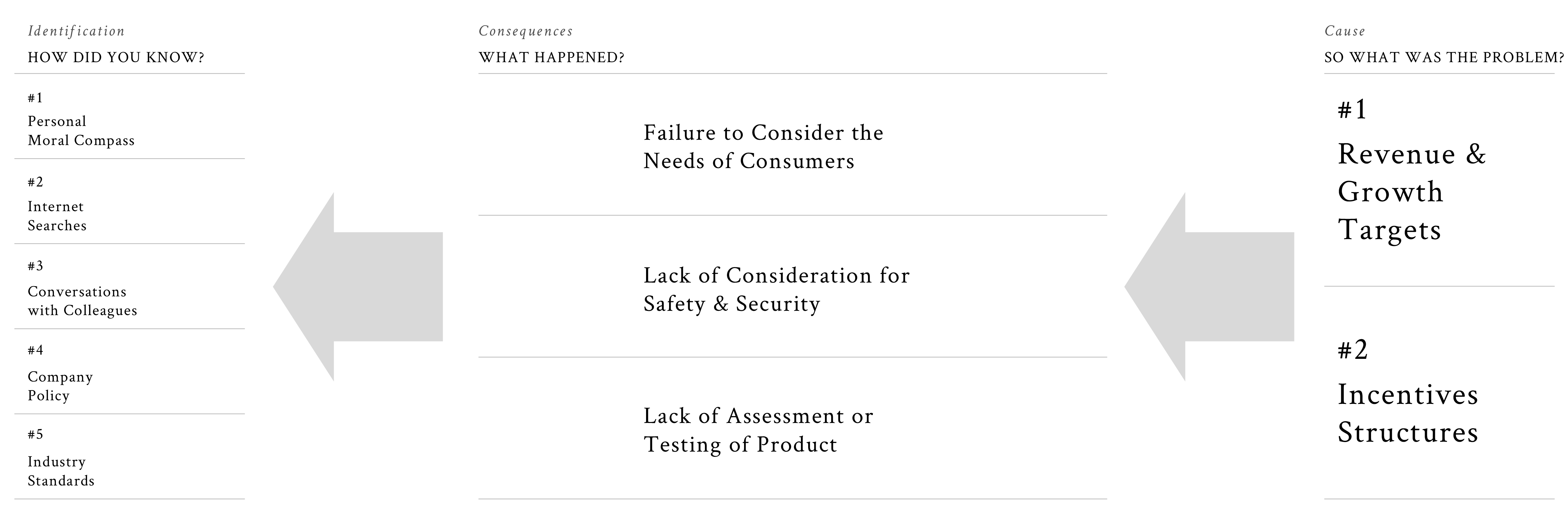
I needed to understand their mental model of the situation so I conducted semi-structured interviews and reviewed literature to understand how employees framed the causes of ethical problems.
But what is an ethical problem?
Based on the historical analysis, there is a broad range to what is understood to be an "ethical problem." I needed to understand how "ethics" was identified in this specific context. As an abstract concept, I knew that a singular definition is diffuse and would not be useful. I was not trying to be a philosopher. Pragmatically, the definition and types of ethics does not matter. For the purposes of designing an intervention, how the human identifies and finds an ethical problem is the design requirement that needs to be accounted for.
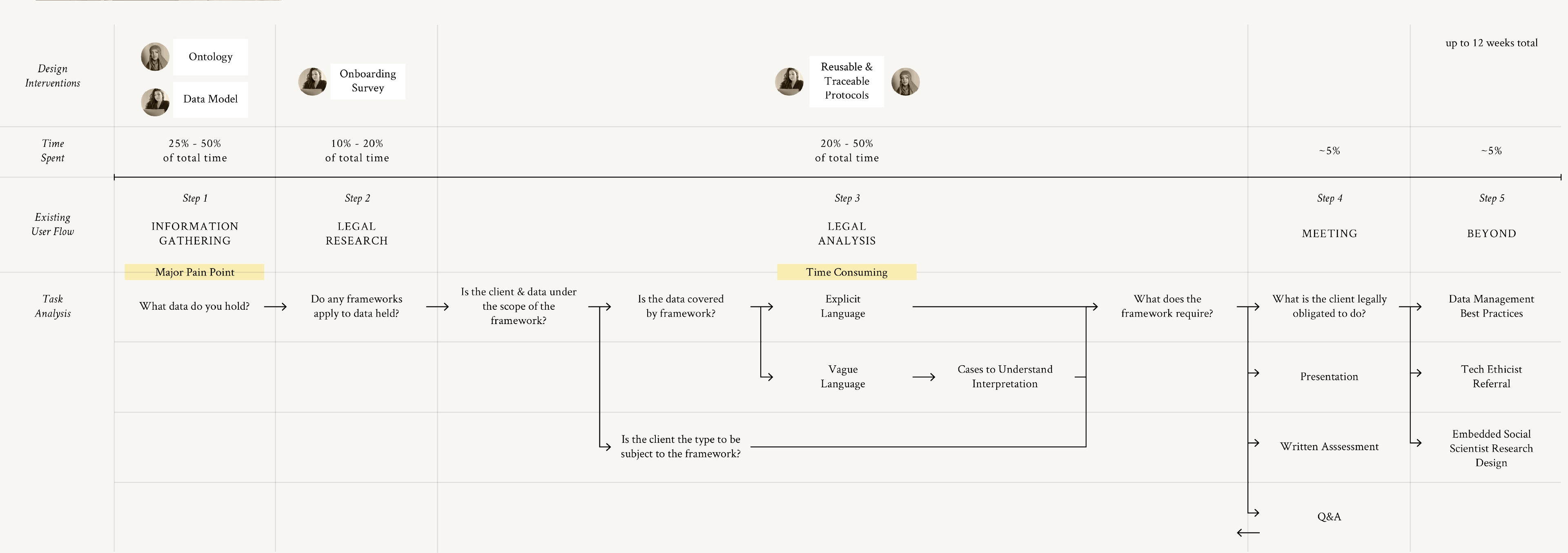
Task Analysis
System Mapping
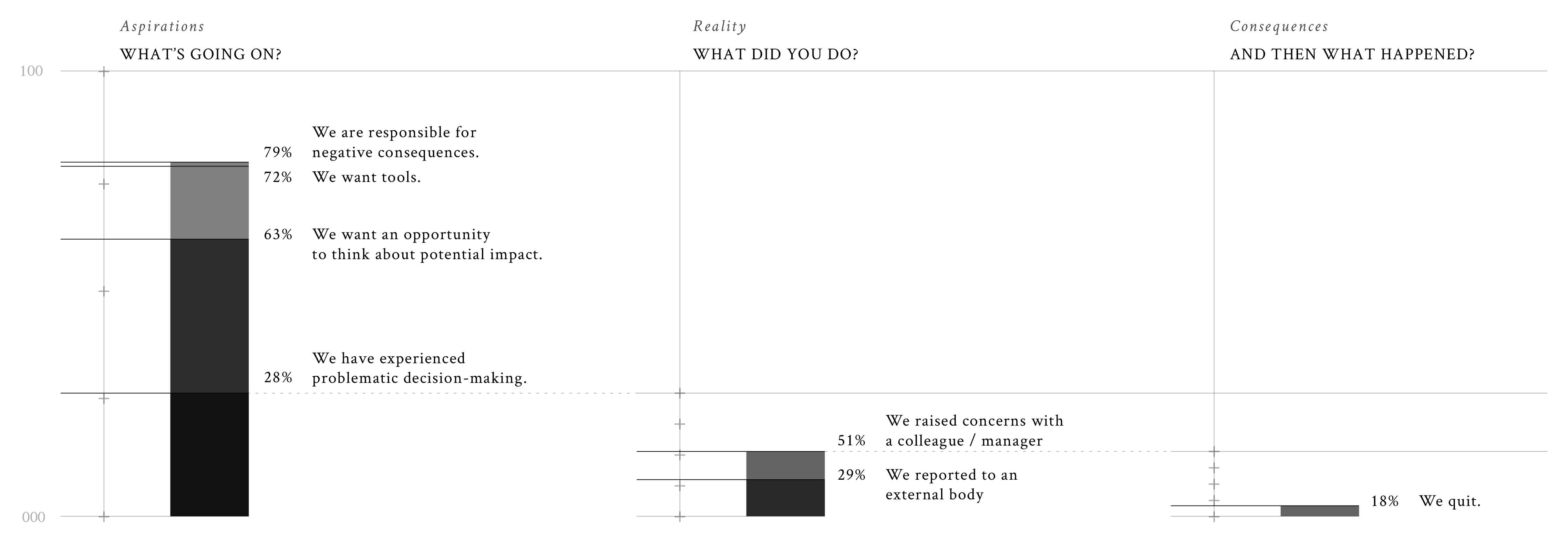
System consequences, inefficiencies, and failures were identified, structured, and contextualized.
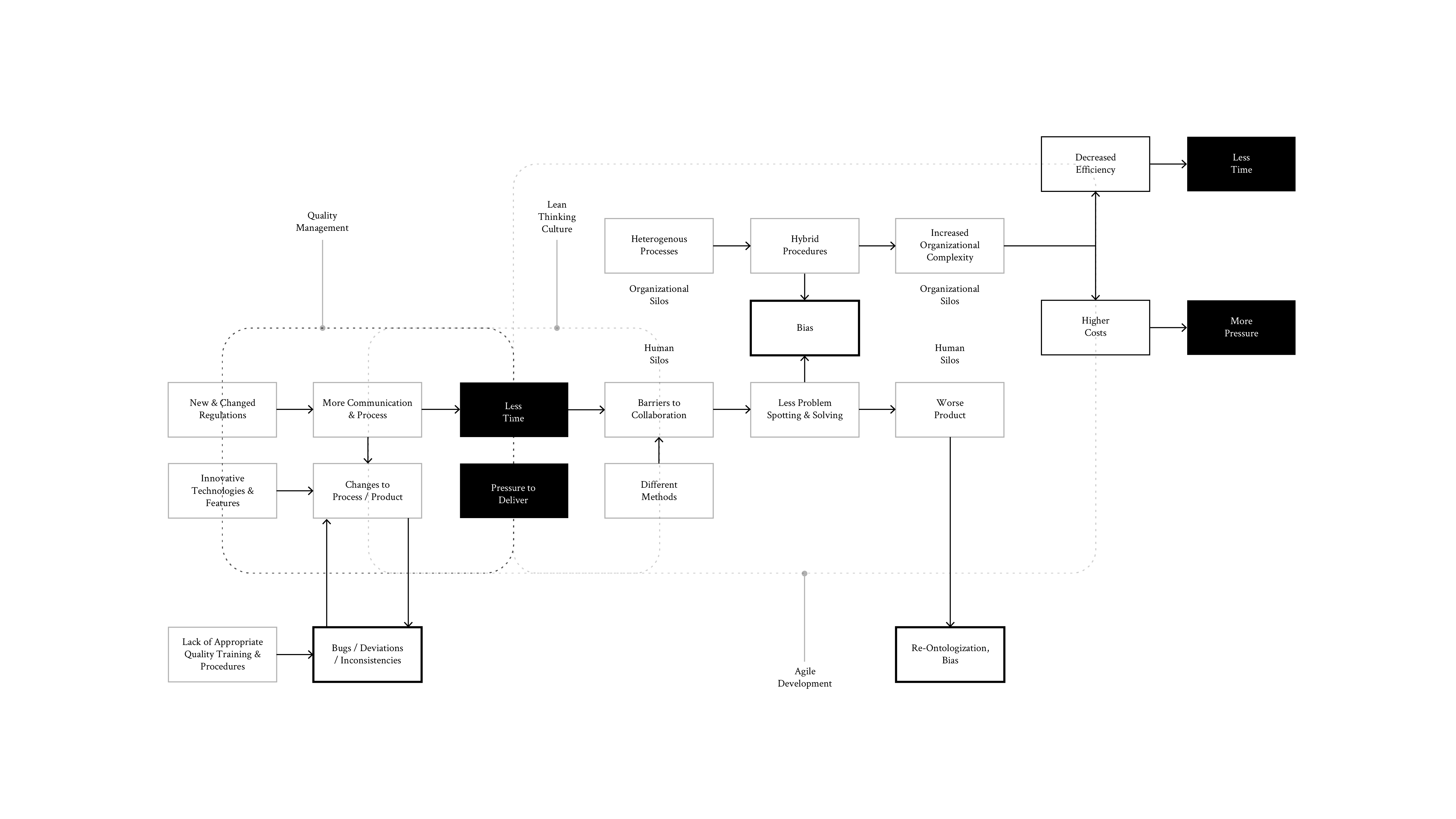
Following Conway's Law, I assessed for gaps in information and communication, then identified where and how bias / insensitivities might enter the system to cause ethical problems. I also identified bugs / deviations / and inconsistencies to be a source of ethical risks due to their impact on the user experience.
Research Synthesis: Problem
The final form is as shown.
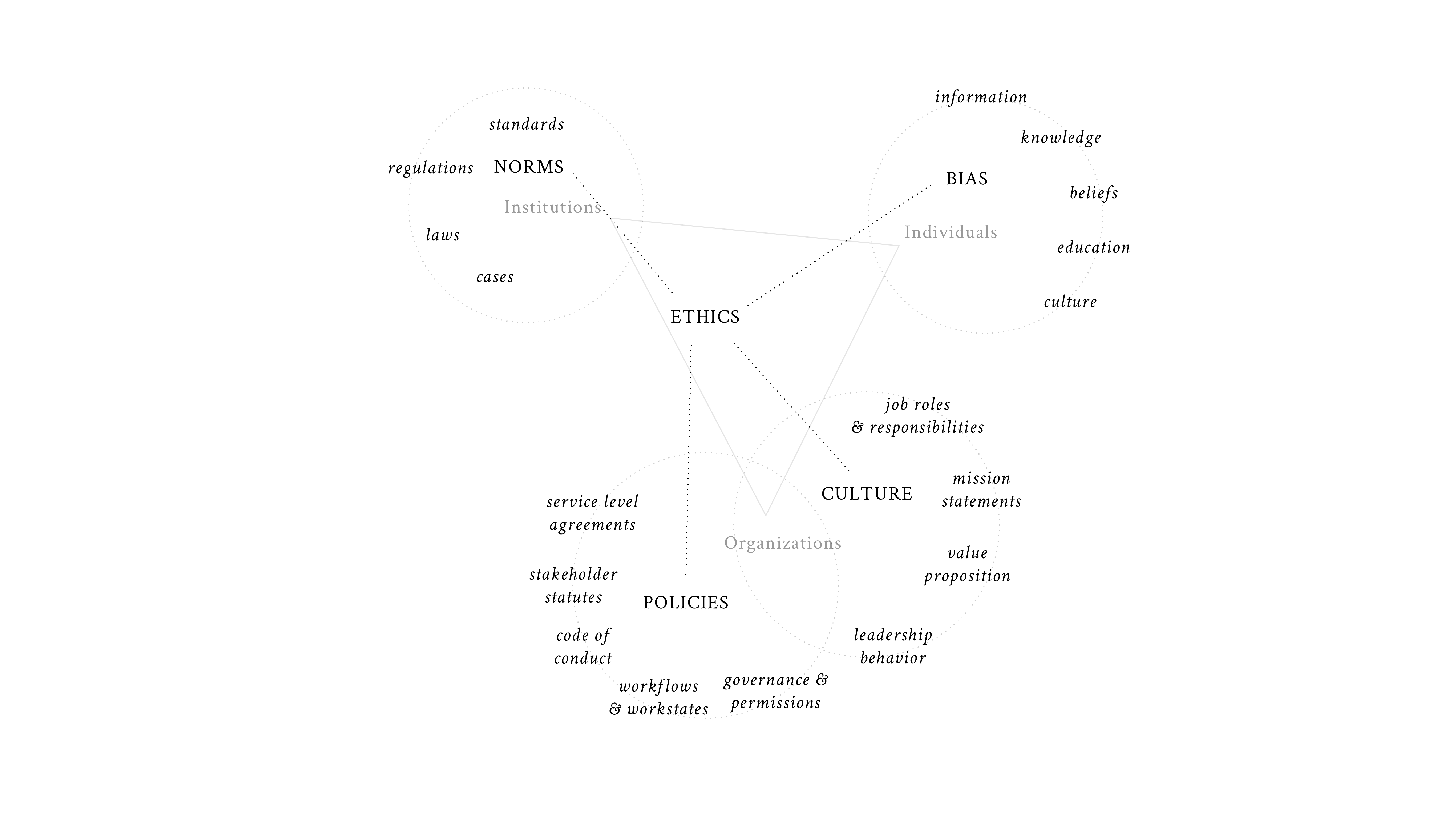
It is how* we design product, not what product we design, that leads to ethical problems.
* how = people + process
Research Synthesis: Object
Research Synthesis: Organization
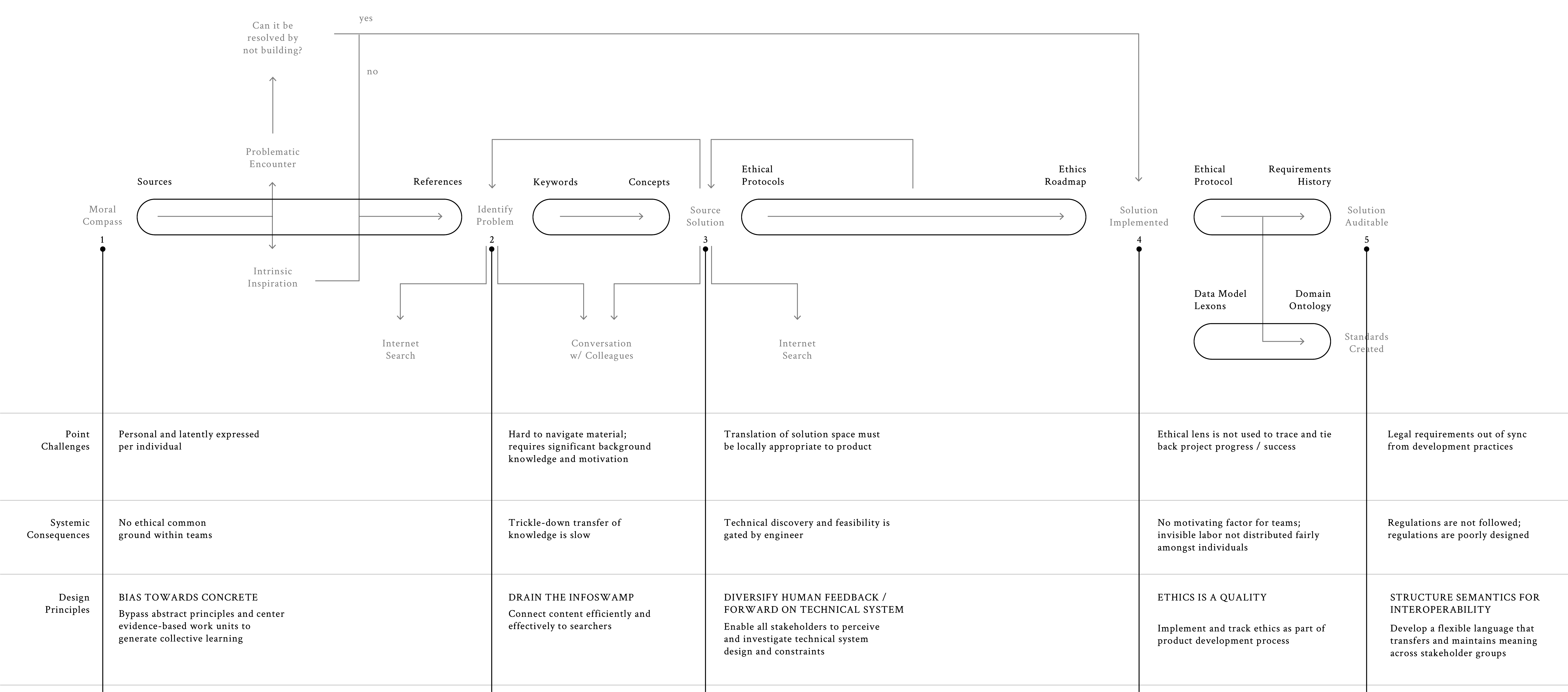
I then roughly designed the objects in accordance with the pain points.
Branding Strategy

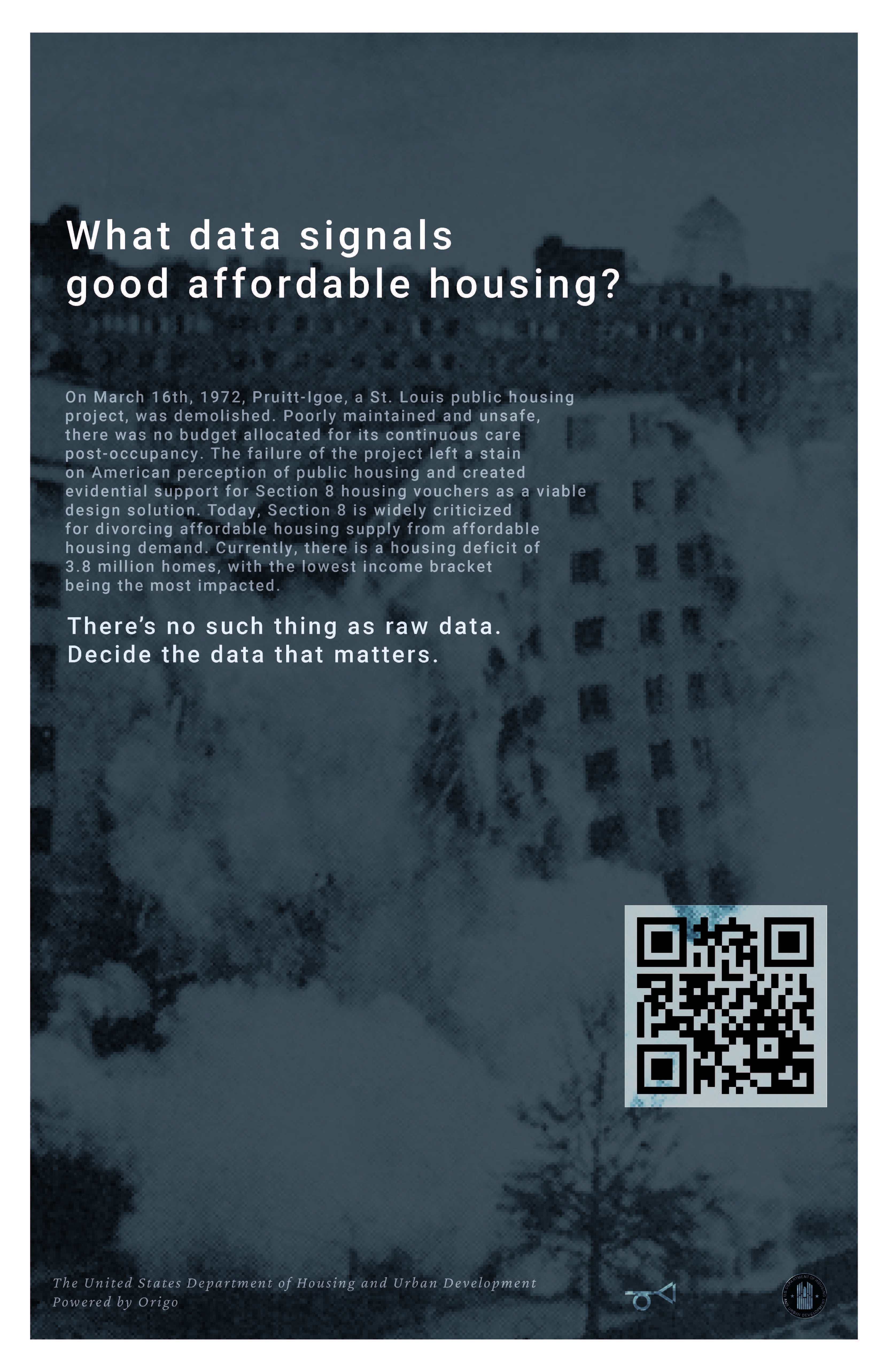
In the following prototype, it is looking at the domain of digital education (MOOCs), but it can also be applied to affordable housing, criminal justice, etc.
Origo believes the future of tech ethics lies in creating a continuous feedback loop between software development and regulatory legislation while enabling a plurality of stakeholders to participate in the construction of data models without needing to be "technical." By democratizing the construction of data models and grounding ethics in everyday context and operations, teams can spot, assess, and mitigate ethical risks in a sandboxed environment while collaboratively sharing their learnings with lawyers and regulators. Technology can be designed to be safe, and regulations can update closer and more elegantly to the speed of innovation.
Origo connects the product team with the information they need to anticipate and mitigate ethical problems at the point of design.
1
Lawyer-in-the-Loop
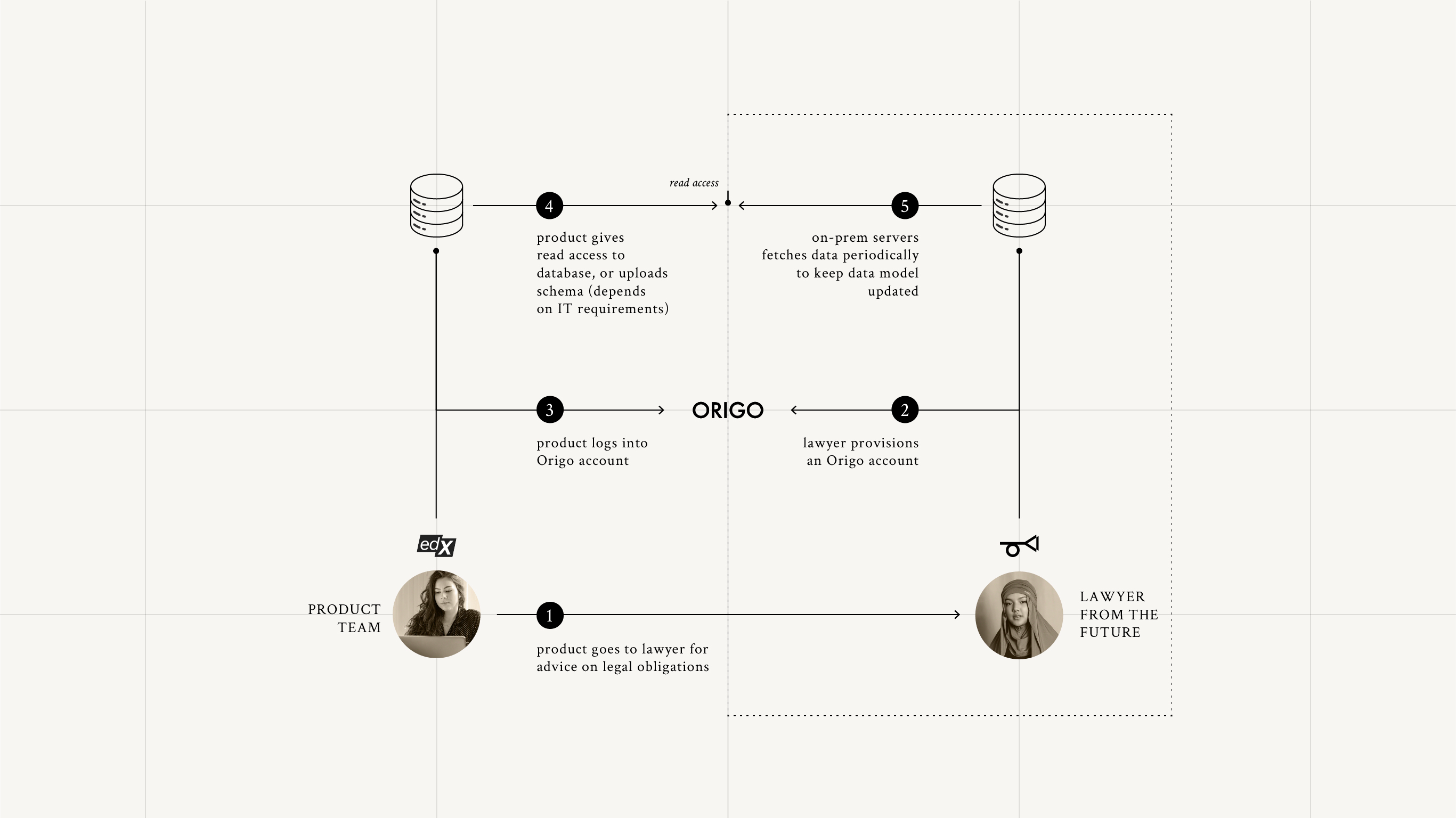
Base requirements are collected directly from lawyers so the product team can bootstrap their data model and design ethically without costly refactors.
2
Legible Ethical Value
Protocols that become design requirements can be created and reused by lawyers, traced, and audited at scale so that the product team's work is visible and of consumer value.
3
Input Diversity
Context on design problems are collected through references representing a spectrum of temporal change and diversity of stakeholders.
4
Product Knowledge Management
References and requirements are collected and managed in direct relation to the product data model so that context is never divorced from object.
Concept Design
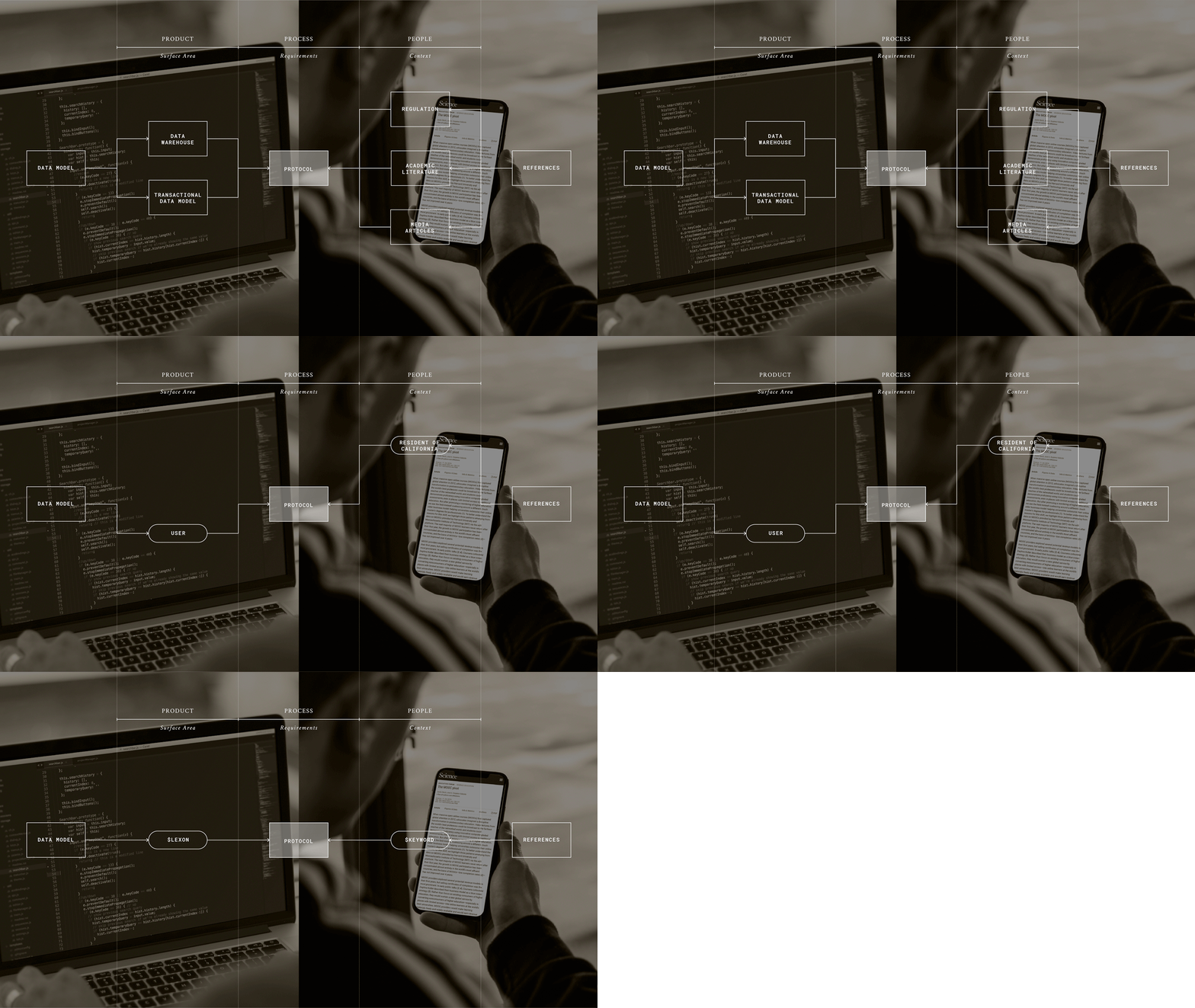
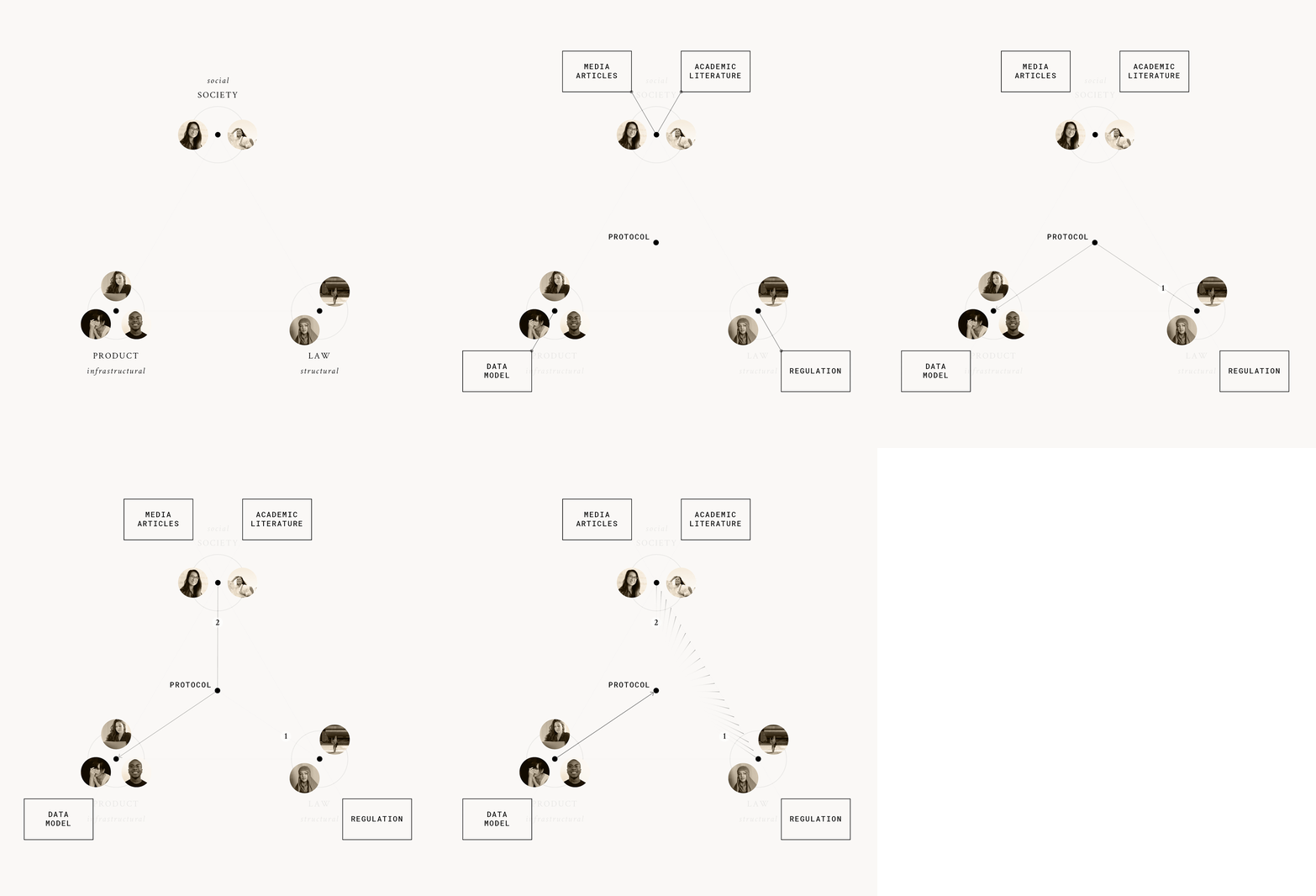
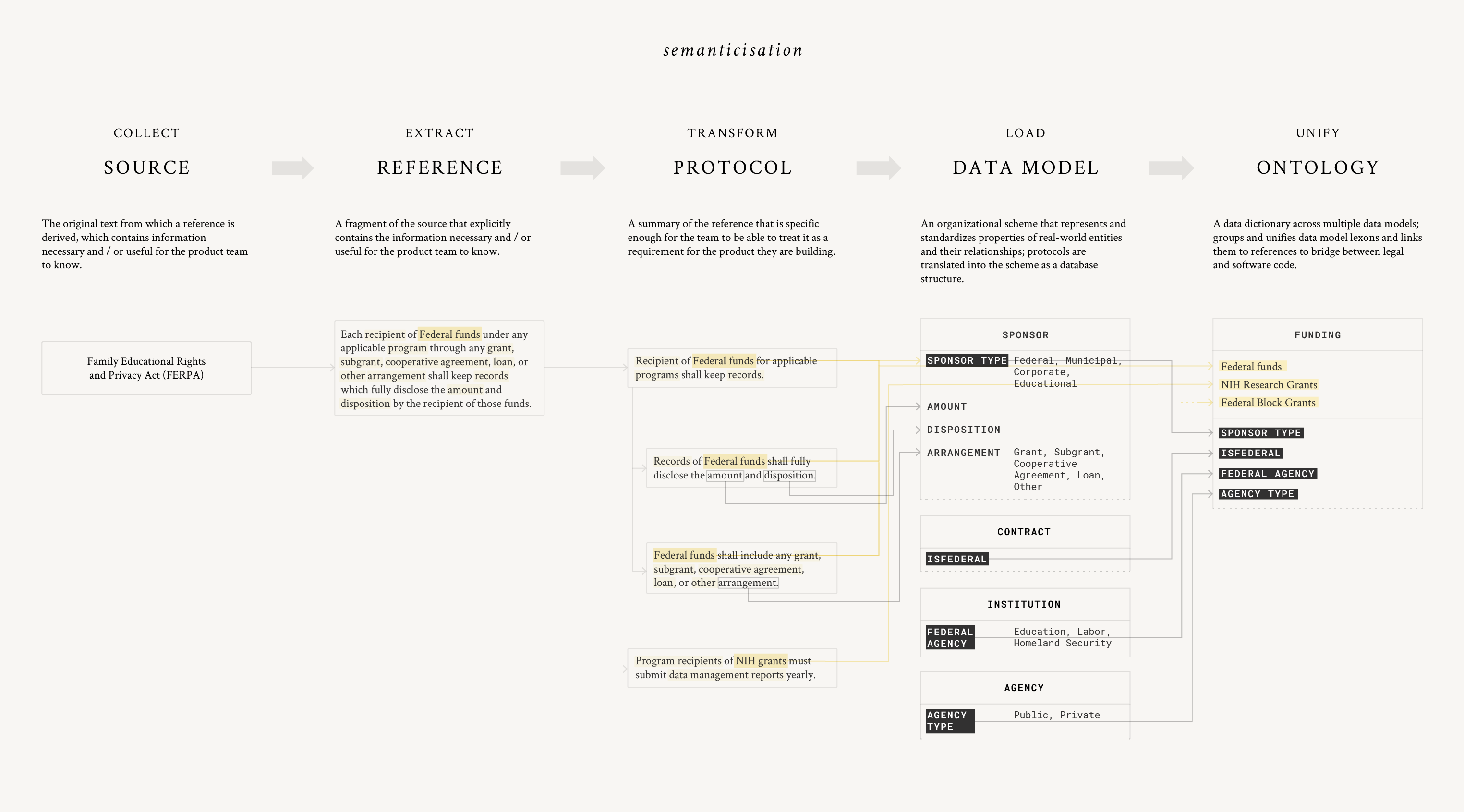
Ethical protocols would also serve to normalize the set of words and their referents into a coherent namespace by pairing lexons (internal vocabulary) with keywords (external vocabulary). As a data object that packaged relevant information, protocols could be traced and a digital space for institutional stakeholders was created for data governance.
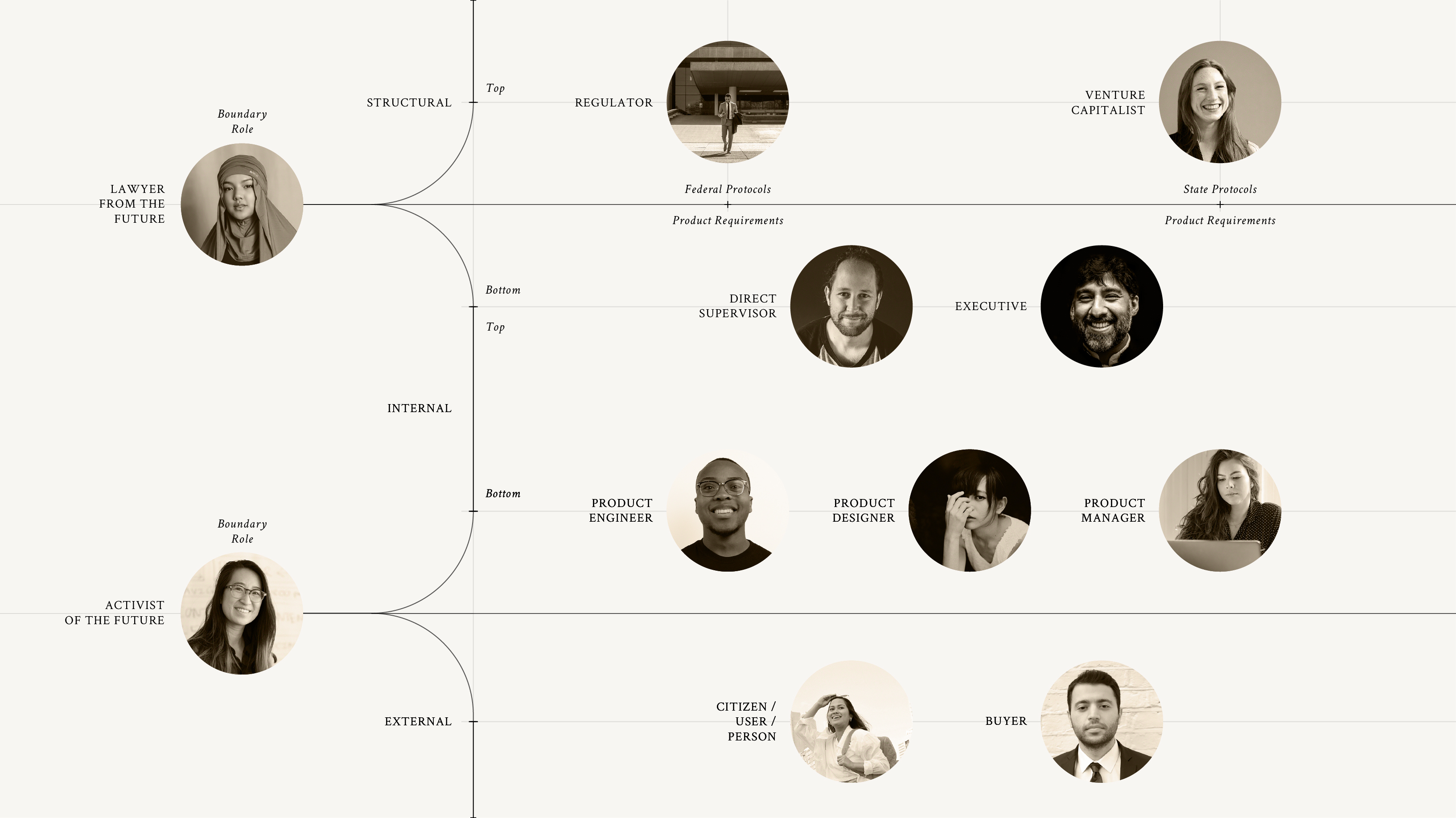
Role Design
Ontological Design
The ontology can also provide a view into optimizing laws created for a common problem by detecting patterns and reverse salients across and within jurisdictions. Over time, data governance can be complex without being complicated.
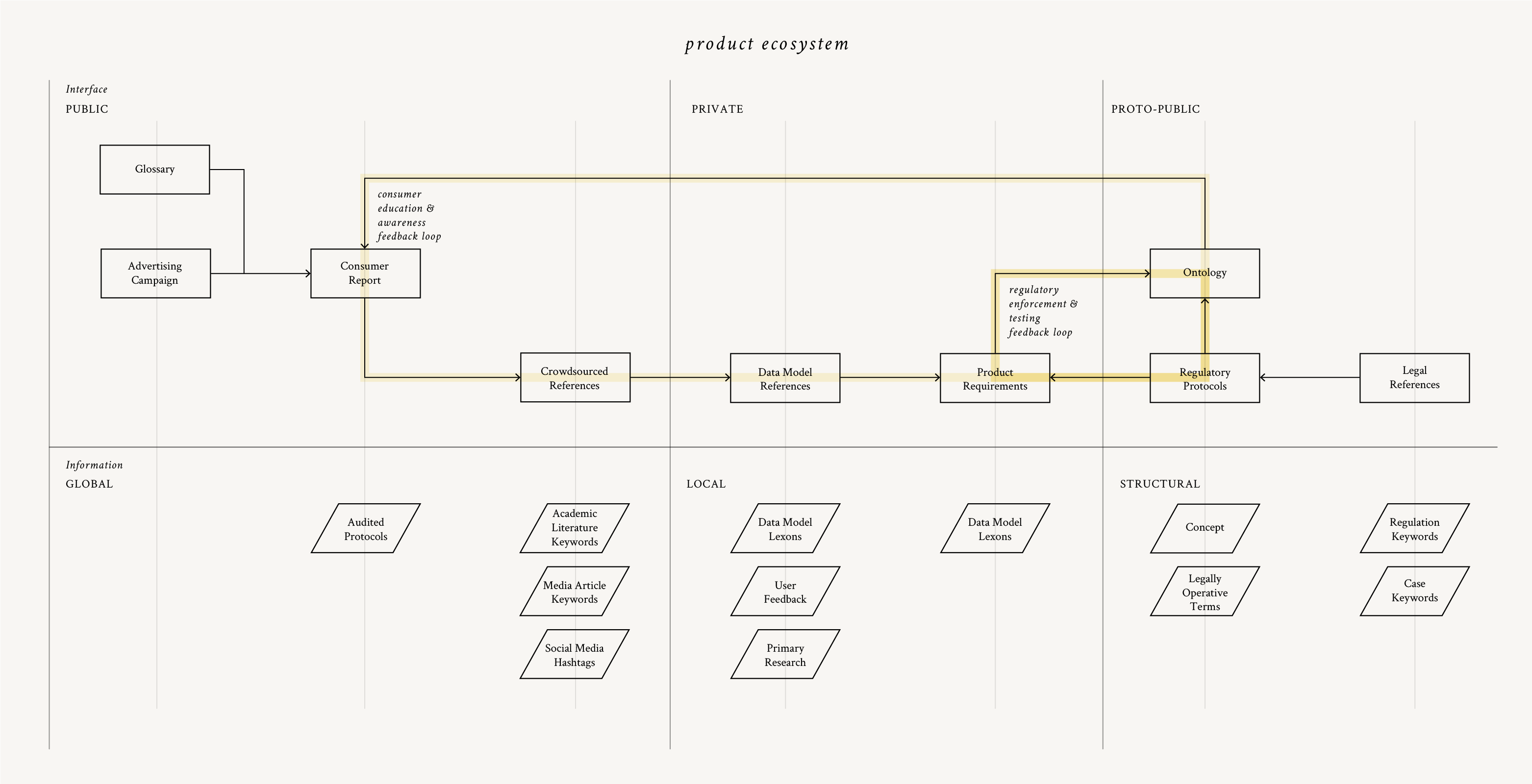
As feedback with product team are maintained, the ontology can also serve as aa data collection mechanism for experiments that might be generalized into new laws.
Given that much of the cost of UX designs are due to architectural changes needed because impedance mismatches, the data model also aids engineers in planning and making trade-offs for product development.
By making a technical object legible, non-technical stakeholders can participate in problem-spotting and designing data.
By abstracting data away from interface, designers can make more conscious design decisions.
Onboarding Design
The landing page of Origo bootstraps the user requirements-gathering process by asking them to define their jurisdiction and anchoring the product in a context and culture.
It then creates a boundary object by visualizing the data model, and directs users to a glossary to give them a common vocabulary for discussion.
For clarity and ease of learning, the glossary eschews the production of new marketing / self-marketing terms to describe what has already been described in other fields to produce a unified vocabulary.
This aids in the creation of a shared multi-disciplinary framework, reduces silos, improves collaboration, and helps in the search for more information.
Task Flows




Visualization Design
By surfacing this within the product, it also passively educates less data-savvy stakeholders on the nuances of data.
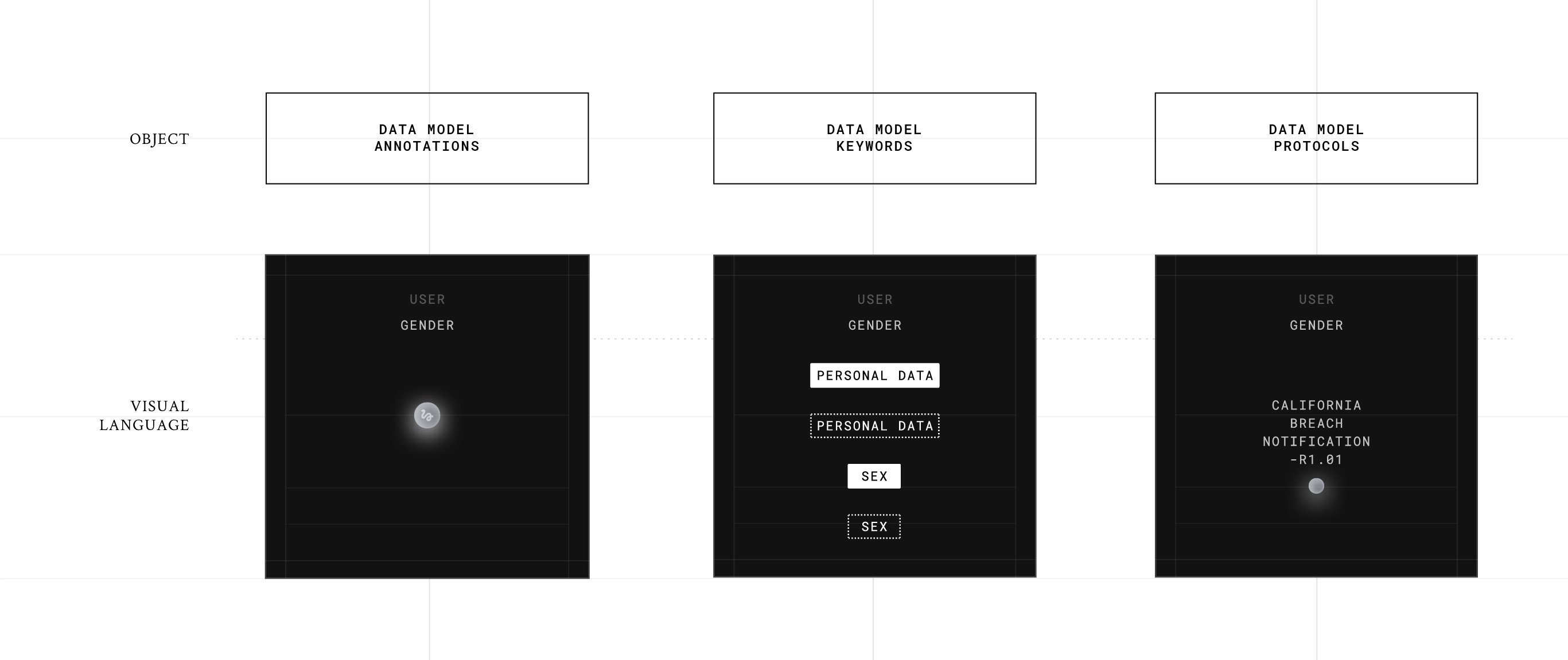
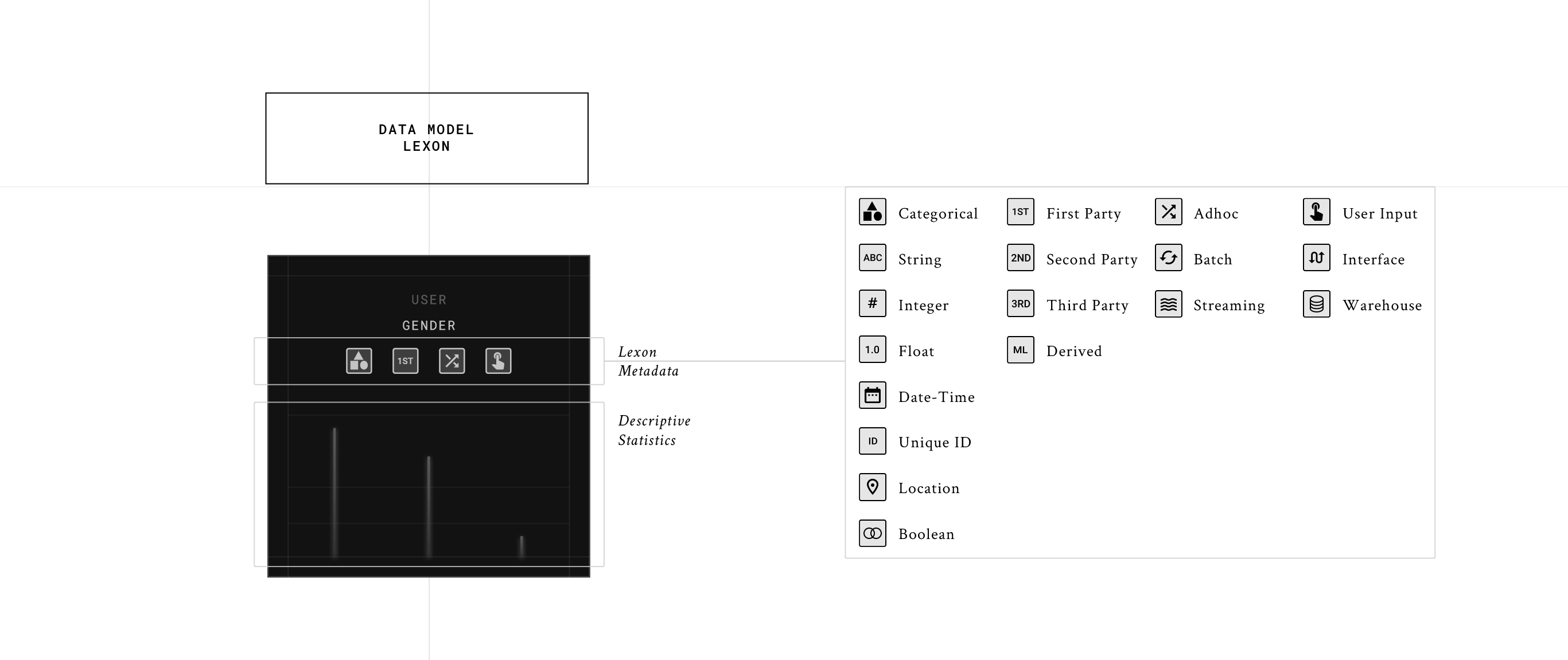
Properties of the keywords relevant to ethical decision-making are also visualized / surfaced.
Concept Validation
Being able to associate individual field names... which will vary quite a bit as you’ve mentioned... under legally operative concepts is actually a huge value add. Especially to the extent that someone from the legal team can define what the legally operative term encompasses, someone from the product team can tag the individual fields... what I see this tool doing is providing a common language and framework...streamlining conversations between people who are dealing with the same concepts but in very different worlds.
- Mason Kortz, Clinical Instructor @Harvard Law School & Affiliate @Berkman Klein
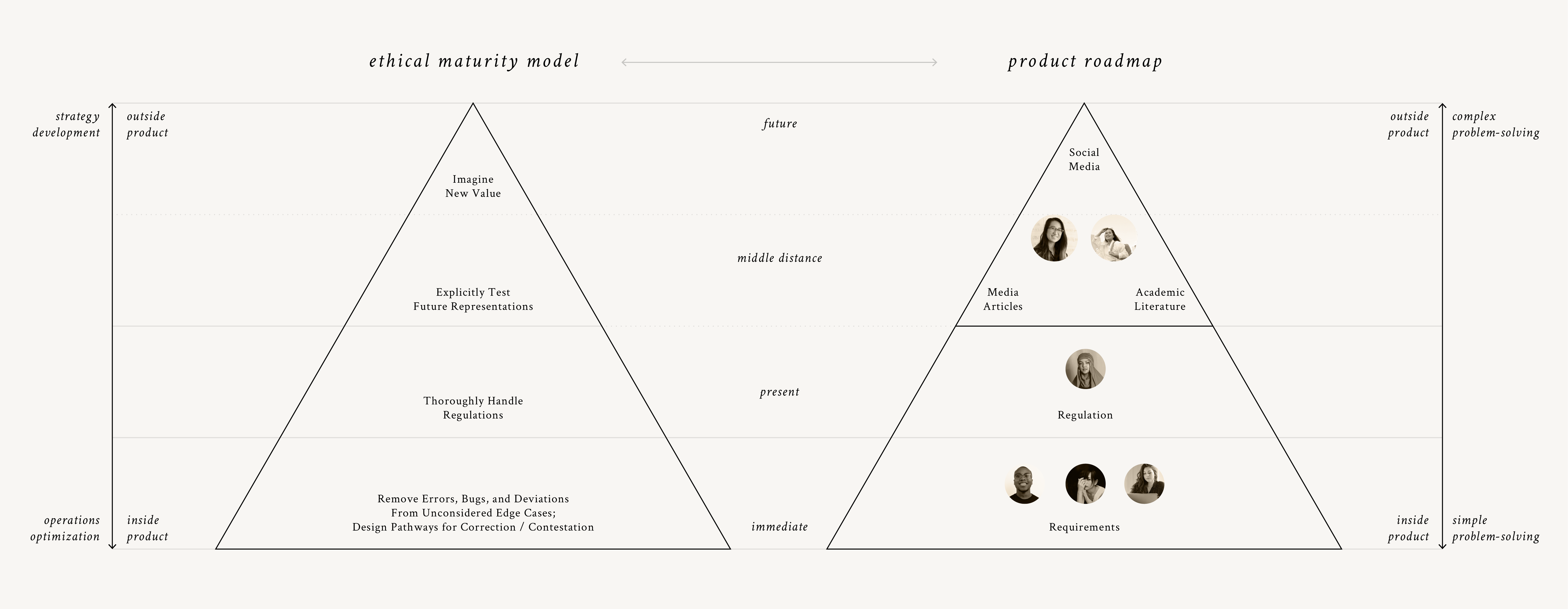
Go-to-Market Strategy
Final Review
Attendees: Dr. Michael Smith (Advisor) Andrew Witt (Advisor) Dr. Tom Dayton (Advisor)
Dr. Martin Bechthold (MDE Program Director) Dr. Mary Tolikas (MDE Program Director)
Bryan Boyer (Future UT Faculty Director)
Next Step
I also presented my thesis work and its curricular evolution at various venues both inside and outside the University of Michigan.